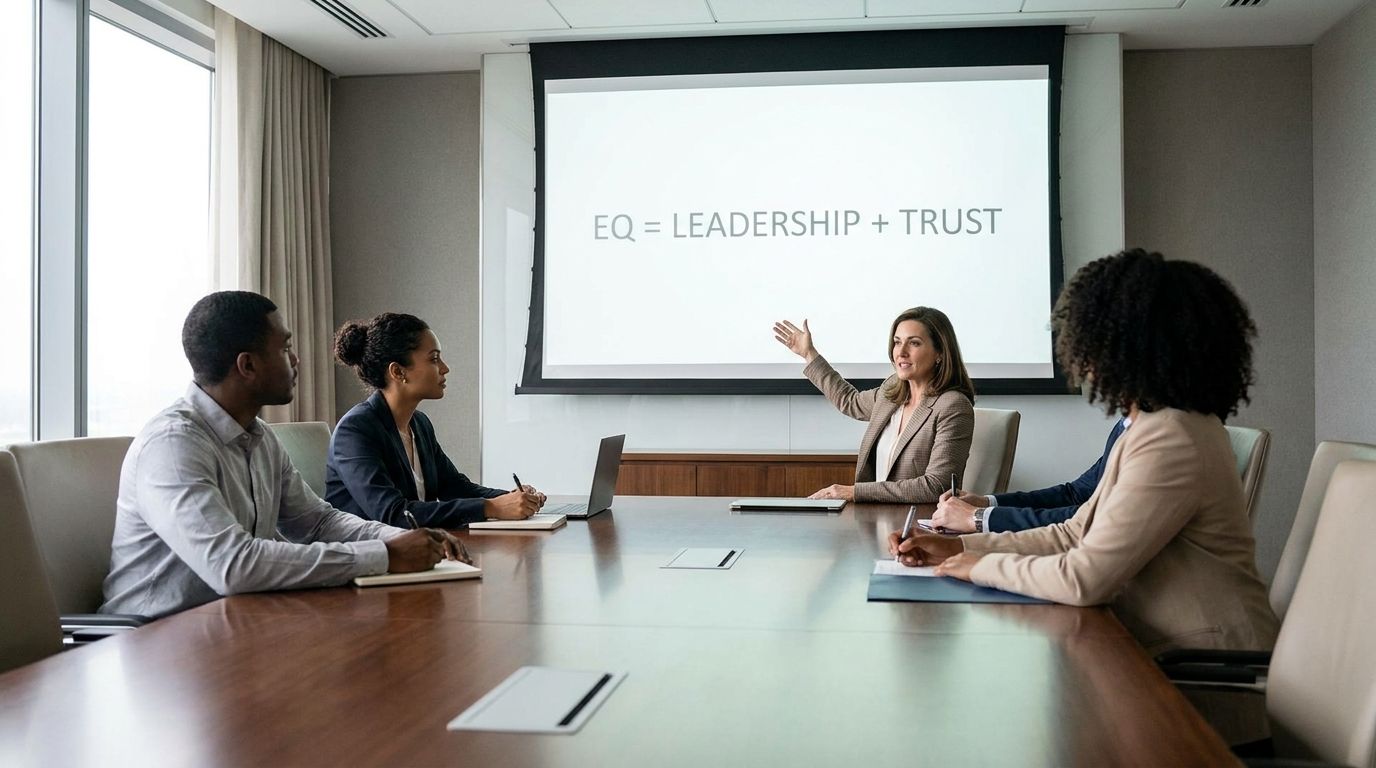
EQ beats IQ in leadership because managers succeed through trust, communication, judgment, motivation, and conflict handling, not technical knowledge alone. The hard data on soft skills shows that emotional intelligence predicts performance, retention, productivity, and manager effectiveness in ways raw intelligence can’t replace.
If you’re deciding whether to invest in emotional intelligence, leadership development, communication skills, or manager training, the numbers make the case. Research from Google, Daniel Goleman, TalentSmart, LinkedIn, the World Economic Forum, and the National Bureau of Economic Research all point in the same direction: people skills are measurable business skills. The term “soft skills” undersells what they do.
Why Are Soft Skills So Important In Leadership?
Soft skills matter in leadership because your results come through other people. You can know the right answer and still fail if your team doesn’t trust you, understand you, or feel safe enough to tell you the truth.
Leadership is a transfer job. You transfer clarity, standards, urgency, confidence, and accountability from your own thinking into a group of people with different pressures and priorities. That transfer depends on emotional intelligence, communication skills, empathy, listening, and social judgment. None of those skills are “soft” when deadlines, turnover, customer issues, and team conflict are on the line.
This is where EQ beats IQ in leadership. Intelligence quotient (IQ) helps you solve technical problems, process information, and learn quickly. Emotional intelligence (EQ) helps you read the room, regulate your reactions, coach performance, resolve friction, and keep people aligned when the work gets messy. The strongest leaders don’t choose between competence and connection; they use connection to turn competence into results.
Does Emotional Intelligence Really Beat IQ For Career Success?
Yes, emotional intelligence often predicts leadership success better than intelligence quotient once a person has the baseline technical ability required for the role. Daniel Goleman’s research found that emotional intelligence was twice as important as technical skills and IQ for superior performance across job levels.
Goleman’s analysis of competency models from 188 companies found that emotional intelligence became even more important at senior levels. For top leadership roles, emotional intelligence accounted for 67% of the abilities linked with outstanding performance. That finding helps explain why some technically gifted managers stall when they move from individual contributor work into roles that require influence, coaching, and organizational trust.
TalentSmart’s emotional intelligence research points in the same direction. Its testing of emotional intelligence alongside 33 other workplace skills, using data from over 2 million test-takers, found EQ to be the strongest predictor of performance, explaining 58% of success across job types. It also reported that 90% of top performers are high in emotional intelligence, giving you a practical reason to treat EQ as a performance lever rather than a personality bonus.
What Did Google’s Project Oxygen Discover About Soft Skills?
Google’s Project Oxygen found that the best managers were defined mostly by behaviors tied to people skills. The top seven manager behaviors identified in the research were all soft skills, and science, technology, engineering, and mathematics (STEM) expertise ranked last among the eight key attributes.
That finding is useful because Google is often associated with technical excellence. If any organization could prove that technical brilliance alone creates great managers, Google would be a strong candidate. Its own internal data pointed elsewhere: the best managers coached, empowered teams, communicated well, supported career growth, created inclusive team conditions, and gave people clear direction.
The lesson for you is direct. Technical expertise can earn credibility, yet leadership credibility fades fast when people feel ignored, micromanaged, confused, or unsupported. Project Oxygen showed that manager quality depends on repeated behaviors your team can feel every week: listening, sharing information, creating clarity, giving useful feedback, and helping people grow.
What Statistics Prove Soft Skills Matter More Than Hard Skills?
The strongest soft skills statistics connect emotional intelligence to performance, leadership quality, hiring decisions, and business outcomes. The pattern is consistent: technical skills open doors, but interpersonal skills often decide who advances, who retains talent, and who delivers through a team.
LinkedIn’s Global Talent Trends research reported that 92% of talent professionals say soft skills matter as much as or more than hard skills when hiring. It also found that 80% say soft skills are becoming more important to company success. The skills named in that research included creativity, persuasion, collaboration, adaptability, and emotional intelligence, which are the same abilities managers use to keep cross-functional work moving.
The Center for Creative Leadership adds a warning from the failure side of the equation. Its research on executive derailment has linked stalled or failed leadership careers to interpersonal relationship problems. That means emotional intelligence isn’t only a “nice to have” for leaders who want to be liked; it’s a risk control skill for managers who need to keep authority, trust, and influence intact.
How Can You Measure The Return On Investment Of Soft Skills Training?
You can measure return on investment (ROI) for soft skills training by tracking business outcomes before and after the training. Focus on productivity, retention, absenteeism, manager ratings, engagement, conflict rates, promotion readiness, and quality of team communication.
The National Bureau of Economic Research working paper on soft skills training for garment workers gives you one of the clearest data points. The study found that training in communication, problem-solving, time management, and financial literacy increased productivity by 12%. It also reported an approximate 250% return on investment within eight months of training, making the business case easier to defend with finance leaders.
Use a simple measurement plan inside your own company. Pick one or two leadership behaviors, connect them to a business metric, set a baseline, train managers, then measure again after a defined period. If you train managers on coaching conversations, track retention, internal mobility, performance review quality, and employee survey items tied to manager feedback. That keeps soft skills development tied to evidence instead of opinion.
Can Emotional Intelligence Be Learned?
Yes, emotional intelligence can be developed through feedback, practice, coaching, reflection, and repeated behavior change. You’re not locked into your current level of self-awareness, self-control, empathy, or relationship skill.
The learnability of EQ matters because many leaders treat emotional intelligence as a fixed trait. That belief lowers accountability. A manager may say, “That’s just my style,” when the real issue is poor listening, rushed feedback, defensive reactions, or weak emotional regulation. Leadership development works best when it turns those patterns into observable behaviors people can practice and measure.
Start with behaviors, not labels. Instead of telling a manager to “be more empathetic,” ask them to summarize what an employee said before responding. Instead of asking someone to “communicate better,” measure whether priorities are stated in plain language, decisions are documented, and team members know what good work looks like. Emotional intelligence improves when you make it specific enough to coach.
What Do Hiring Managers Value More, Hard Skills Or Soft Skills?
Hiring managers still need hard skills, but many talent professionals now rate soft skills as equal to or more important for long-term success. Hard skills help someone qualify for a job; soft skills often determine whether they can collaborate, adapt, lead, and grow inside the role.
This distinction matters most in leadership hiring. A manager who knows the technical work but can’t coach, listen, resolve tension, or build trust creates drag across the team. People slow down, avoid hard conversations, withhold problems, and spend energy managing the manager instead of doing the work. That cost rarely appears in a job description, yet it shows up in missed deadlines, turnover, and poor morale.
Strong hiring processes test for interpersonal skills directly. Use structured interviews, work samples, reference checks, and behavior-based questions tied to real manager duties. Ask candidates how they handled disagreement, gave difficult feedback, rebuilt trust, or helped a struggling employee improve. You’re not searching for charm; you’re searching for repeatable leadership behavior.
Why Does The Future Of Work Demand EQ?
The future of work demands EQ because technical change increases the need for adaptability, learning, trust, and human judgment. The World Economic Forum’s Future of Jobs Report ranked several people-centered and self-management skills among the top skills employers need, including resilience, flexibility, self-awareness, empathy, active listening, leadership, and social influence.
Technology changes the work, but people still decide whether teams learn fast enough to keep up. Leaders need to help employees handle ambiguity, adopt new tools, discuss risks, and shift priorities without burning out. That requires more than technical training. It requires communication discipline, emotional steadiness, and the ability to keep people engaged when the plan changes.
This is why soft skills belong in workforce planning, not just leadership retreats. If your organization treats emotional intelligence as optional, you’ll underinvest in the skills that help people adapt. If you build EQ into hiring, manager development, promotion criteria, and performance reviews, you create leaders who can handle complexity without losing the room.
How Do You Argue For Soft Skills Investment At Work?
You argue for soft skills investment by connecting it to measurable business problems. Don’t sell emotional intelligence as personal growth; connect it to productivity, retention, manager effectiveness, engagement, customer experience, and leadership bench strength.
Start with the pain your company already recognizes. If turnover is high, show how manager behavior affects retention and team trust. If productivity is uneven, show how poor communication, unclear priorities, and conflict slow execution. If promotions are failing, show how technical experts need people skills before they manage teams.
Then present the evidence in plain terms. Google found that its best managers were defined mostly by soft-skill behaviors. Goleman found emotional intelligence was twice as important as IQ and technical skill for superior performance. TalentSmart linked EQ to 58% of job success across roles. The National Bureau of Economic Research study showed measurable productivity and return on investment gains after soft skills training. That is the hard data on soft skills your business case needs.
Does Emotional Intelligence Matter More Than IQ For Leadership Success?
- Yes.
- EQ predicts leadership behavior.
- IQ supports technical judgment.
- Great managers need trust, empathy, communication, and influence.
- That’s why EQ beats IQ in leadership.
Stop Calling Them Soft When The Results Are Hard
Soft skills aren’t soft when they determine whether people trust you, follow you, stay with you, and do their best work. The data points to the same conclusion from several angles: Google’s manager research, Goleman’s emotional intelligence findings, TalentSmart’s performance data, LinkedIn’s hiring research, the World Economic Forum’s skills rankings, and the National Bureau of Economic Research productivity study. If you want stronger leadership, don’t treat EQ as a personality trait or a workshop topic. Treat it as a business capability you can hire for, develop, measure, and improve. That’s the practical reason EQ beats IQ in leadership: leadership is judged by what your team can do because of how you lead.
References
- Harvard Business Review: What Makes A Leader?
- TalentSmart Emotional Intelligence Research
- National Bureau Of Economic Research: The Value Of Soft Skills In The Labor Market
- World Economic Forum: Future Of Jobs Report
- LinkedIn: Global Talent Trends
- Businessolver: Workplace Empathy Monitor
- Center For Creative Leadership: Why Leaders Are Derailed
- The Washington Post: Google Project Oxygen Coverage
- Dale Carnegie: Soft Skills Resources